Archeologists, students unearth Archer County
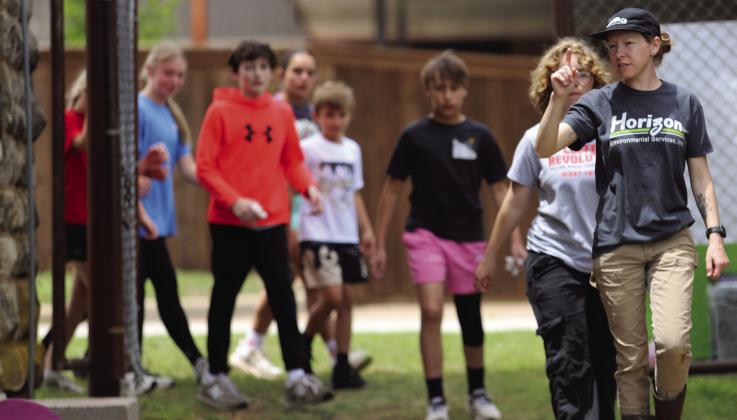
Archer City native and Austin-based archeologist Kailey Berube was on her way to an archeological survey in Oklahoma City early in 2024 when she had an idea she believed would benefit both her hometown museum project and her employer’s desire to do a community outreach project. Her unique idea led to the Unearthing Archer County event held last week, May 7 to May 10, attracting stakeholders from across the state and impacting the lives of hundreds of local students and citizens.
Berube, a 2009 graduate of Archer City High School, pitched the idea during the trip to her teammate Jesse Dalton, who, like Berube, works as a principal investigator for Horizon Environmental Services of Austin. He was not initially impressed by her idea of an archeological dig at the old county jail from her hometown.
“He was a hard no at first. It took a little convincing,” Berube says.
Dalton explains, “She had mentioned that there was a historic, aging jail . . . that was very unique. And my initial response was ‘Absolutely not.’” The historical context, unfamiliar small town and the choice of a jail did not interest him.
“And then she says, ‘Just wait, and you’ll see it,’” Dalton continues. “So, we came here, and she showed me the community. We went to Murns; we went to the Legion. The next day we took a tour of the jail.”
Dalton had to admit that Berube was on to something. “It’s like, oh my gosh, you were completely right!” he laughs. By the end of the tour, he and Berube had a solid plan for an event. They were both excited.
“Not only is the architecture rare,” Dalton explains, “... but in Texas, to see a jail that is still standing and still in pretty moderately decent shape, it’s unique and it’s rare and it’s significant.”
Built in 1910, the old Archer County Jail is on the National Register of Historic Places and is a State Antiquities Landmark for Architecture. Both the jail and the county courthouse were designed by renowned Texas architect Alonzo N. Dawson, whose work spanned 25 years and made significant contributions to architecture in the state. He is known for his skill in the Romanesque Revival style, the style of both Archer County buildings.
The jail operated until 1974, when a replacement jail was constructed. For over four decades following closure, it stood as a museum owned by the county and ran by community members, including local historian Jack Loftin.
In 2020, the building was sold to the nonprofit Archer County Museum and Arts Center (ACMAC) organized by Dan Haile, Jerry Phillips, and John Phillips, all of whom had ties to Archer County. Among other goals, they set about the restoration of the building. They hired the museum’s first director, Callie Lawson, and established a board of directors.
The ACMAC considers the jail to be its largest artifact and plans to restore the jail to a living museum, what Dalton calls “a snapshot in time where people can visit and get a taste of what their history… our collective history is.”
Such a restoration project is expensive. Despite recent structural stabilization and a new roof, an expensive list of repairs remains.
“In order to bring money, we need to bring awareness,” Dalton says. “The best thing we can do is a community public outreach archeological dig— engage the students, engage young minds of the county, get the citizens involved by opening up the archeological dig on Saturday.”
Archer City ISD sent students from kindergarten through grade 12. Karley Buerger, who helped organize the event locally, brought her first-grade class from Windthorst Elementary. About 430 students participated.
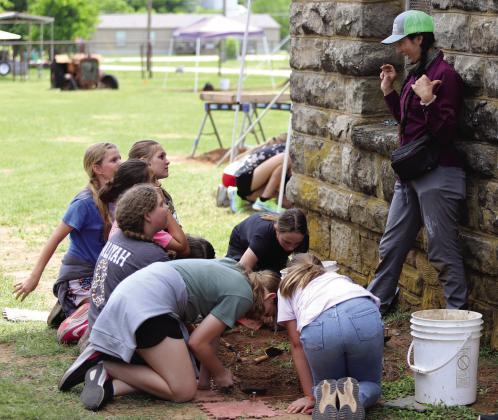
Berube estimates twenty professionals from Horizon, the Texas Historical Commission (THC) and the Texas Archeological Society volunteered to make the event a success. Together they taught and demonstrated methodology on an archeological dig and how to set up excavation units to uncover material remains associated with activities that took place throughout the lifespan of the jail.
After setting up excavation units, students were invited to “trowel down carefully and screen the dirt,” Dalton explains, to separate artifacts from sediment. They bagged and tagged artifacts and learned how to take notes using the metric system and scientific methodology.
“They just loved it because you’re finding artifact after artifact, and it’s really exciting for them,” Dalton says. “So, you find these artifacts and then a story kind of begins to develop, and it really humanizes and personifies the artifacts that you are finding.”
“I really enjoyed learning about the screening process,” one fifth grade student remarks, “and my favorite find were bones!”
Students found numerous pig and cow bones, possible evidence of inmate dinners. They also uncovered white-ware ceramics that have not been used since the 1920s, and one group unearthed the hammer of a plastic toy gun from the 1940s. Archeologists led students to hypothesize about its owner. They decided it probably belonged to the sheriff’s son since the sheriff’s family lived on the bottom floor of the jail.
In addition to the dig, students participated in art projects led by the THC. One station involved molding clay pinch pots.
“I really enjoyed getting to work with the clay and make art pieces that will someday be a part of history!” the student says.
For seventh grader Able McCown, the big takeaway was technique. “It was fun. I learned to dig the proper way. Even the ground instead of just digging in,” he explains.
Several students returned to the public dig on Saturday. One such student was high school senior Enya Reeve. “I thought it was really cool sifting through the dirt to find out what had been around the Archer County jail.”
River Schreiber, a fifthgrade student from Archer City and perhaps a future archeologist, also returned to the site Saturday with her siblings. This time their parents came along.
“This is really cool because I’ve always been like, oh my gosh ..., there’s probably so much stuff over here and it could be so cool to dig it up,” Schreiber explains. “But I never thought anyone would actually do it until now.”
Tiffany Osburn, Deputy State Archeologist of the Archeology Division at the THC, summarizes the week with a smile. “Boy! I am so impressed by the number of kids who have come through. This is an incredible project!” she exclaims. “This doesn’t happen in every community in Texas.”
“And the fact that they brought in [so many] students ... over the course of three days,” she continues, “I mean, really that’s a lot of touch points in kids’ lives for archeology and history that they often don’t get in nearly the same way in the classroom.”
Osburn also gives the community high marks for “so much local investment and oral history and involvement in projects like this.”
Throughout the week, an Austin-based film crew captured activities in preparation for a mini documentary. They interviewed professionals hosting the event and locals such as Brad Mitchell and Johnny Bart Hudson.
The film crew was also on hand for the Saturday evening events, where Berube and Dalton kept the dig energy alive at the Royal Theater with a porch party, presentation of findings, fajita dinner and live music. A local band called Young County Recalls warmed up the audience for the highlight of the evening, a star-studded musical performance by Tony Kamel and the Bluegrass Felons. It turns out Dalton is also a stand-up bass player and vocalist.
“I am fortunate enough to be also a bluegrass musician,” Dalton says. “So, I have at my beck and call some of the best players in the state.” Joining Dalton and lead vocalist and guitarist Kamel were Dennis Ludiker on the fiddle, Trevor Smith on the banjo, and Noah Jeffries on the mandolin.
Michael Wren, who has both attended and organized many concerts at the theater since its rebirth in 2000, was floored by the performance. “That’s the most talented group of musicians we’ve ever had together on the Royal Stage,” Wren announced at the end of the evening.
Berube explains that projects like this one are uncommon. With the help of the local community, state agencies, and the ACMAC board, she believes they were able to create a framework for future outreach projects by Horizon while also increasing community and state awareness of the jail restoration.
She looks back at the event with a sense of pride in being able to share her passion with her hometown, a place she plans to call home again beginning this summer as a remote employee for Horizon.
“Through a public outreach archeological investigation, it is our shared vision to not only protect the jail from becoming a slowly eroding eyesore, but also to raise awareness and funding to reopen it as a living museum, repository of artifacts and a stop on a vehicular heritage trail,” Berube notes.
She believes the event had a significant impact on the jail’s future and remains optimistic that the ACMAC, which welcomes a new director Jennifer Singleton in June, will be successful in achieving these goals.