ACMAC hosts 4th, 7th grades on Archer County History Bus Tour Field Trip
The Archer County Museum and Arts Center hosted 4th and 7th graders from across the county at multiple historic Archer County sites as part of the first of its kind bus tour on Tuesday, Dec. 10.
Students from Archer City, Holliday and Windthorst attended a field trip which taught them the history of historic sites like the Stonewall Jackson Camp, the Comanche Tree Marker, Lindemann Drilling, the old Archer County Jail, the Archer County Courthouse, Royal Theater and St. Mary’s Church as part of the event.
“One of my goals it to get the idea across that these roads that we drive didn’t just magically appear here, the economy in which we work in didn’t just magically appear here, the police and department didn’t just all appear here,” ACMAC Board President Dan Haile said. “The day I was born it didn’t just show up here, it showed up way, way, way before then and it evolved.”
Students rotated across the sites throughout the day on a schedule created by ACMAC board member and WISD teacher Karley Buerger. The students were treated to a lunch at the Royal Theater that was prepared by ACMAC board member Mike Humpert.
'The field trip was a priority for our students in the county,' Buerger said. 'Over 200 students were able to experience and learn more about the county they live in, and see monumental locations that have formed their families history too. This field trip was an amazing opportunity for many, because of how important it is to learn about the county they live in and the how to continue sharing the important history that makes us all who we are too.'
History of the stops: Archer County was named after Branch Tanner Archer. Archer was born in Virginia in 1790 and received a medical degree. In 1831, Archer arrived in Texas. He fought in the Battle of Gonzales and later served in the First Congress of Texas and as Speaker of the House in the Republic of Texas House of Representatives second session. Texas gave out many land grants in Archer County to those who fought at the Alamo, Goliad, and San Jacinto. In many cases, the heirs received the land grant for those who died in pursuit of liberating Texas.
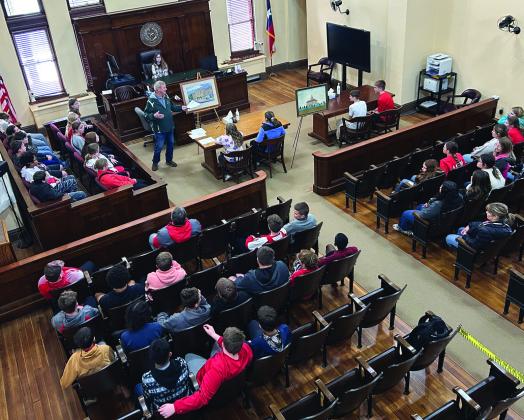
The first courthouse was donated by Dr. C.B. Hutto. The current courthouse was constructed in 1891. However, it used to only have two floors and a dome on top. In 1925, the dome was removed, and a third floor was established in its place. This stop’s docent was ACMAC board member Jerry Phillips.
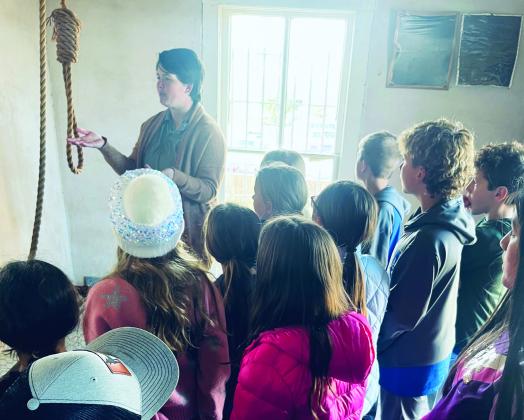
The three-story jail was used from 1910-1974, when a new jail building was built, and the building was decommissioned as a jail. Quickly, the community turned the space around into a museum and officially opened its doors in the summer of 1975. The museum was run by volunteers and attracted thousands of people to the county over the decades. This stop’s docent was ACMAC Executive Director Callie Lawson.
The United Confederate Veterans monument in the Stonewall Jackson camp lists all the charter members and the history of the camp on the other side. Area Confederate veterans formed the camp in 1897 as a place for meetings in reunions.
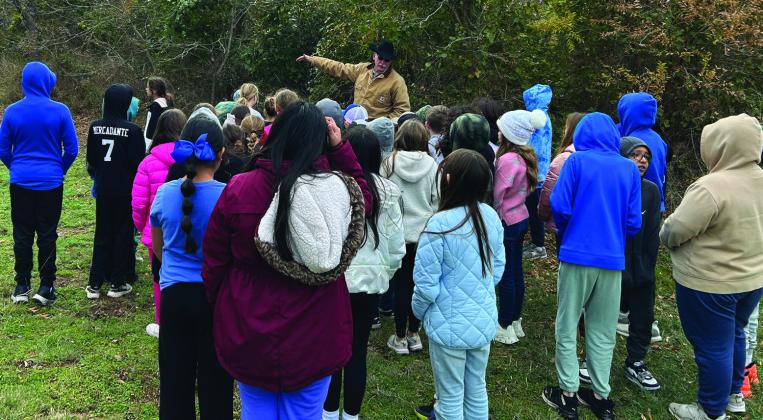
The Comanche Nation Marker Tree is in the park along Holliday Creek, two miles south of Holliday on FM 368.
“Those who view this sacred marker tree will have an understanding and significance of native culture for generations to come,” is written on the monument near the tree.
The tree was certified by the Texas Tree Historical Coalition in November of 2011 and claimed by the Comanche Nation on June 2, 2017. This stop’s docent was ACMAC Vice President Brad Mitchell.
Saint Mary’s Catholic Church has served as the backbone of the Windthorst community for 133 years. Its establishment can be traced back to 1891 when Dorr Clark and Duncan C. Plumb began negotiations with Circle Ranch for 75,000 acres of land for the establishment of a new colony between Archer and Clay counties. The contract specified that the land was from Catholics of German descent. This stop’s docent was Florence Anderle.
Early agreements stated that Clark and Plumb agreed to supply $3,000 for a church, rectory, and a school; 20 acres located in the center of the proposed colony were allotted as property of the church.
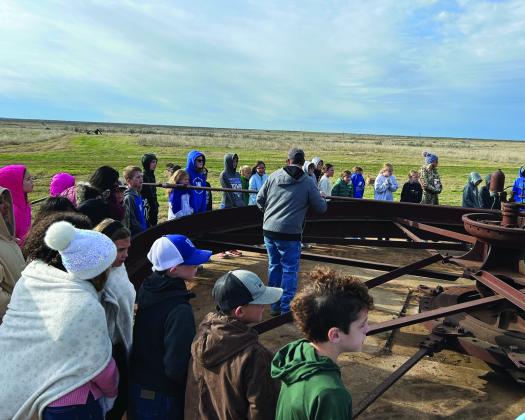
At Lindemann Drilling students discussed the history of oil, oil production and how oil is used today. Archer County used to be the third largest oil producer in the state of Texas and played a large role in the economics of a new county. This stop’s docent were Shane and Doug Lindemann and Tanya Choate.
Drawing inspiration from the past: The Archer County Museum and Arts Board drew inspiration from the Windthorst ISD Texas history field trip it took every summer starting in the 1990s until COVID-19 ended the trip in 2021.
“What we’re doing is locally inspired on what Nancy Scott started over 25 years ago,” Haile said.
Scott, who taught 26 years at Windthorst ISD, said it took three years of convincing Superintendent Howard Neeb at the time to allow the trip to take place. She added she wasn’t aware of any other schools in the area which were taking a similar trip.
“I had gone to a history teacher’s convention, and I was taken on all these tours and thinking ‘the kids need to see this,’” Scott said. “That gave me insight into what all was available in Austin and San Antonio. So, I planned it all down to the minute. We didn’t have a second to spare.”
She added that the trip evolved every year and the seventh grade Texas history students would see different stops each year and the trip eventually dropped a day removing Sea World/ Fiesta Texas as a stop, but mainstays included the state capitol, San Fernando Cathedral, and the Alamo.
“You can read all of this in a book, and I applaud that greatly,” Scott said. “But going down there to see those buildings that have been there for so many years and to walk where those famous people have walked. I just had to do it.”
In 1997, one lucky Windthorst class of seventh graders was able to meet Governor George Bush. The governor spoke to the class about the exemplary TAAS status Windthorst ISD had, the most interesting person he got to meet as Governor, and whether he planned to run for President. That group of students was also able to sit in on a portion of a session of the Senate and House of Representatives.
Haile’s mother, Donna, was a long-time teacher at Windthorst ISD and often attendee of the Texas History trip to San Antonio and Austin. He did not understand at the time why it was important for his mom and these students to go on this trip, but as he has gotten older, he has gotten a better appreciation for the trip.
“I realized that the impact that had to have on every one of the kids to some small degree, but there were some kids in there that you opened up a whole new aspect of their life by introducing something to them,” Haile said.
“When you grow up in Windthorst, you grow up in that church but maybe you don’t know the history of it as well because you grew up with it,” He continued. “But you sure don’t know about the Comanche Tree over in Stonewall Jackson Camp that’s on the other side of the county. It’s about getting all these kids in these buses and trying to get them to different places.”
What’s Next for ACMAC and the Texas History Bus Trip: The Archer County Museum and Arts Center is a non-profit organization geared towards restoring and preserving the history of Archer County. In the last couple of years, the ACMAC has been established to create a plan to preserve and restore the old Archer County jail and museum. Currently most of the contents of the old jail have been cataloged, and the plan is to work towards complete restoration of the old jail and museum, to provide the history to be preserved for the present and future citizens of all of Archer County.
“Since the ACMAC is a non-profit, most of our funds come from grants and fundraising efforts,” Executive Director Callie Lawson said. “Although, we’re working towards establishing enough funds to restore the old jail. We have found the importance of giving back and educating our youth in the county.”
Despite it being the first year that the ACMAC has put on this Archer County History bus tour was put together, they have received glowing accommodations from the three Archer County schools for putting on the event.
“Archer County has important places, too, that established people here and made it possible for people to live here,” Scott said. “That needs to be honored and realized as well.”
The Archer County Museum and Arts Center hope to continue this trip as an annual tradition for years to come, but can only do so with the support of the community, “We can only do this because it’s people’s passion,” Haile said. “They didn’t pay Nancy Scott any extra money to do that. It was because she was passionate about it. Karley Buerger didn’t do all this work because she was going to get extra money. She did it because she’s passionate about. Everybody does this because they are passionate about Archer County and our legacy, history, and preservation. We need people that believe in that to come help through either time, treasure, or talent.”